
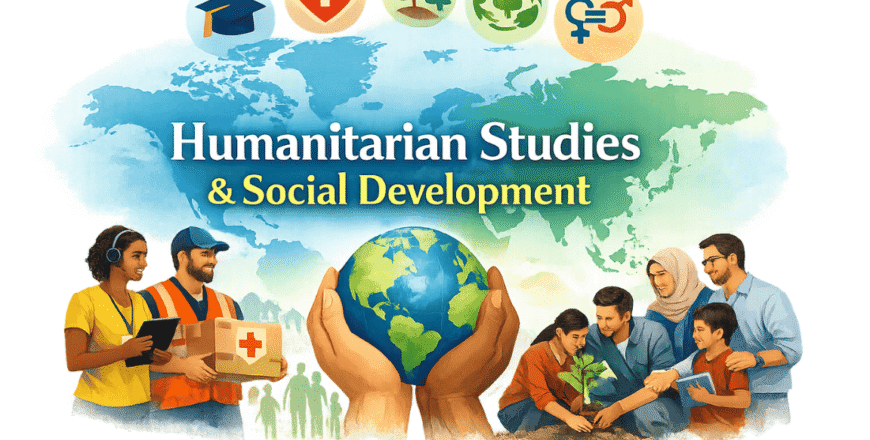
Humanitarian Studies & Social Development

- Description
- Curriculum
The Diploma in Humanitarian Studies and Social Development (PanafDip.) is a professional training program designed to equip learners with the knowledge, practical skills, and ethical frameworks required to work effectively in humanitarian aid, social development, and community empowerment initiatives.
Rooted in African realities but aligned with global standards, the program covers the theories, practices, tools, and innovations shaping humanitarian and development work today. Learners are guided through the full cycle of development programming—from needs assessment to project design, implementation, evaluation, policy advocacy, governance, and humanitarian action.
Upon completion, graduates are awarded the prestigious PanafDip. designation, recognizing them as competent professionals ready to contribute to sustainable, accountable, and people-centered development practices across Africa and beyond.
Program Objectives
By the end of the course, learners will be able to:
Understand the principles and frameworks of humanitarian studies and development practice.
Apply practical tools such as logframes, M&E matrices, capacity-building frameworks, and sustainability checklists.
Design and manage effective humanitarian and social development programs.
Engage in advocacy and policy dialogue to influence governance and social change.
Promote accountability, ethics, and transparency in humanitarian and development work.
Anticipate trends and embrace innovation in development practice.
Course Modules
Module 1: Foundations of Humanitarian Studies and Social Development
• Theories, concepts, and frameworks.
Module 2: International Development Frameworks
• SDGs, international charters, and global governance.
Module 3: Social Development Approaches
• Rights-based, participatory, and sustainable models.
Module 4: Humanitarian Principles and Practice
• Ethics, neutrality, impartiality, and humanitarian law.
Module 5: Gender, Equity, and Inclusion in Development
• Mainstreaming equity and social justice.
Module 6: Community Development Approaches
• Participatory methods, local ownership, empowerment.
Module 7: Program Design, Implementation, and Evaluation
• PCM, M&E frameworks, sustainability tools.
Module 8: Resource Mobilization and Partnership Development
• Fundraising, donor relations, NGO–government partnerships.
Module 9: Capacity Building and Training for Development Practitioners
• Training needs analysis, facilitation, and evaluation.
Module 10: Advocacy, Policy Engagement, and Governance
• Rights-based advocacy, influencing policy change.
Module 11: Contemporary Issues and the Future of Development
• Humanitarian action, global trends, innovation in practice.
Assessment and Certification
• Continuous Assessment: Assignments, case studies, reflections.
• Final Examination: Multiple-choice and applied project tasks.
• Capstone Project: Application of program design, advocacy, or humanitarian response.
Learners who successfully complete all requirements will be awarded:
🎓 Diploma in Humanitarian Studies and Social Development (PanafDip.)
Professional Recognition
Graduates are entitled to use the post-nominal title “PanafDip.” after their names.
Example:
• Jane Doe, PanafDip.
• Ahmed Musa, PanafDip.
This title reflects professional competency, ethical standards, and academic achievement in humanitarian and social development practice.
Career Opportunities
Graduates of the program can pursue roles such as:
• Humanitarian program officer
• Development project manager
• Community mobilizer
• Policy and advocacy officer
• Monitoring and evaluation specialist
• Social development consultant
✨ Empowering Development Leaders for Africa and Beyond.
-
1
 Lesson 1: What is Humanitarianism?
Humanitarianism refers to the belief and practice of helping people who are suffering, especially during crises such as wars, natural disasters, poverty, or displacement. Humanitarian action aims to save lives, reduce suffering, and maintain human dignity.
-
2
Lesson 2: History of Humanitarian Aid
Humanitarian action has evolved over centuries. Although helping others has always existed in human societies, modern humanitarian systems developed mainly in the 19th and 20th centuries.
-
3
Lesson 3: Key Humanitarian Principles
Humanitarian work follows ethical guidelines that ensure aid is delivered fairly and responsibly. These are known as the humanitarian principles.
-
4
Lesson 4: Major Global Humanitarian Organizations
Humanitarian action is carried out by many international organizations, NGOs, and government agencies. These organizations coordinate efforts to respond to emergencies and support development.
-
5
Module 2 Case Study Activity (30–40 minutes)
Compare Two Countries Using HDI Indicators
-
6
Lesson 1: What is Social Development?
Social development refers to the process of improving the well-being and quality of life of individuals and communities.
-
7
Lesson 2: Human Development Index (HDI)
Measuring development is important for understanding how well societies are improving. One widely used measure is the Human Development Index (HDI).
-
8
Lesson 3: Social Inequality and Poverty
High levels of inequality can slow social development and create social tensions.
-
9
Lesson 4: Community Development Concepts
Community development focuses on improving the social, economic, and environmental conditions of local communities.
-
10
Lesson 3.1: Absolute vs Relative Poverty
Poverty is one of the most significant challenges facing societies worldwide. It refers to the condition in which individuals or groups lack sufficient resources to meet basic needs and maintain an acceptable standard of living.
-
11
Lesson 3.2: Causes of Global Poverty
Poverty does not occur for a single reason. Instead, it is often caused by a combination of economic, social, political, and environmental factors.
-
12
Lesson 3.3: Inequality and Social Exclusion
Inequality occurs when resources, opportunities, and rights are distributed unevenly within a society.
-
13
Lesson 3.4: Poverty Reduction Strategies (1 Hour)
Reducing poverty is a central goal of global development. Governments, international organizations, and communities use various strategies to improve living conditions and create opportunities for disadvantaged populations.
-
14
Lesson 4.1: Foundations of Humanitarian Ethics
Humanitarian work involves assisting people who are experiencing extreme suffering due to disasters, conflicts, or social crises.
-
15
Lesson 4.2: The Four Core Humanitarian Principles
Humanitarian organizations operate according to four widely recognized principles that guide their actions. These principles ensure that assistance is delivered fairly, safely, and effectively.
-
16
Lesson 4.3: Humanitarian Law and Human
Humanitarian work is closely connected to international law and human rights frameworks that aim to protect people during crises, especially during armed conflicts.
-
17
Lesson 4.4: Ethical Challenges in Humanitarian Work
Humanitarian workers often operate in environments where ethical decisions are complex and difficult. Limited resources, political pressures, and security risks can create serious ethical dilemmas.
-
18
Lesson 5.1: Types of Disasters (Natural and Human-Made)
Disasters are sudden or gradual events that cause serious disruption to communities, resulting in human suffering, economic losses, and environmental damage.
-
19
Lesson 5.2: The Disaster Management Cycle
Disaster management refers to the systematic process of preparing for, responding to, and recovering from disasters.
-
20
Lesson 5.3: Emergency Response and Humanitarian Coordination
When disasters occur, rapid and coordinated action is necessary to protect lives and reduce suffering.
-
21
Lesson 5.4: Disaster Risk Reduction (DRR)
Disaster Risk Reduction (DRR) refers to strategies and actions designed to reduce the risks and impacts of disasters before they occur.
-
22
Lesson 6.1: Understanding Community Development
Community development refers to the process through which individuals and groups work together to improve the social, economic, and environmental conditions of their communities.
-
23
Lesson 6.2: Participatory Development Approaches
Participatory development is an approach that encourages active involvement of community members in all stages of development initiatives.
-
24
Lesson 6.3: Empowerment and Capacity Building
Empowerment is a central concept in community development and refers to the process of enabling individuals and groups to gain greater control over decisions and resources that affect their lives.
-
25
Lesson 6.4: Local Leadership and Sustainable Community Projects
Local leadership plays a vital role in successful community development initiatives. Community leaders help organize development activities, encourage participation among residents, and represent community interests when working with governments or development organizations.
-
26
Lesson 7.1: Public Health and Social Development
Public health plays a fundamental role in social development by promoting the physical and mental well-being of individuals and communities.
-
27
Lesson 7.2: Education and Social Change
Education is one of the most powerful tools for promoting social development. It enables individuals to acquire knowledge, develop skills, and improve their opportunities for employment and participation in society.
-
28
Lesson 7.3: Social Welfare Systems
-
29
Lesson 7.4: Gender Equality and Social Inclusion
-
30
Lesson 8.1: Introduction to the Sustainable Development Goals
The Sustainable Development Goals (SDGs) are a set of global goals adopted by the United Nations in 2015 to address major social, economic, and environmental challenges facing the world.
-
31
Lesson 8.2: Poverty, Hunger, and Human Well-being in the SDGs
A central focus of the Sustainable Development Goals is improving human well-being by addressing poverty, hunger, and health challenges.
-
32
Lesson 8.3: Environmental Sustainability and Climate Action
Environmental sustainability is a critical component of the Sustainable Development Goals. Human activities have significantly impacted natural ecosystems, leading to problems such as climate change, deforestation, biodiversity loss, and pollution.
-
33
Lesson 8.4: Achieving the SDGs: Global Partnerships and Local Action
Achieving the Sustainable Development Goals requires collaboration among governments, international organizations, businesses, and civil society.
-
34
Lesson 9.1: Introduction to Development Project Planning
Development projects are organized efforts designed to address specific social, economic, or environmental problems within a community or region.
-
35
Lesson 9.2: The Project Cycle in Development Work
Development projects typically follow a structured sequence of stages known as the project cycle.
-
36
Lesson 9.3: Stakeholder Engagement in Development Projects
Stakeholder engagement is an important aspect of project planning and implementation in social development.
-
37
Lesson 9.4: Monitoring and Evaluation in Development Projects
Monitoring and evaluation (M&E) are essential components of development projects.
-
38
Lesson 10.1: Career Opportunities in Humanitarian and Development Work
Humanitarian and development work offers a wide range of career opportunities for individuals interested in addressing social, economic, and environmental challenges.
-
39
Lesson 10.2: Skills Required for Humanitarian and Development Professionals
-
40
Lesson 10.3: Volunteering and Internships in Humanitarian Work
Volunteering and internships play an important role in preparing individuals for careers in humanitarian and development sectors.
-
41
Lesson 10.4: Future Challenges and Opportunities in Humanitarian Work
Understanding these challenges helps prepare future professionals to contribute effectively to humanitarian and development efforts.
-
Introduces principles of humanitarian action and social development.
-
Provides practical knowledge in NGO management and fundraising.
-
Examines humanitarian logistics, disaster response, and crisis management.
-
Targeted at students, NGO staff, volunteers, and professionals pursuing impact-driven careers.
-
Participants may append the professional designation PanafDip. after successful completion.
-
Explores global humanitarian frameworks, ethics, and international law.
-
Basic Education: Minimum high school qualification.
-
Devices & Internet: Access to a phone/computer with reliable internet.
-
English Proficiency: Ability to read and write in English.
-
Time Commitment: 3–5 study hours per week.
• Development practitioners
• NGO staff and volunteers
• Humanitarian aid workers
• Social entrepreneurs
• Policy makers and advocates
• Students and graduates aspiring to work in international development or humanitarian fields